

Strategy · GEO
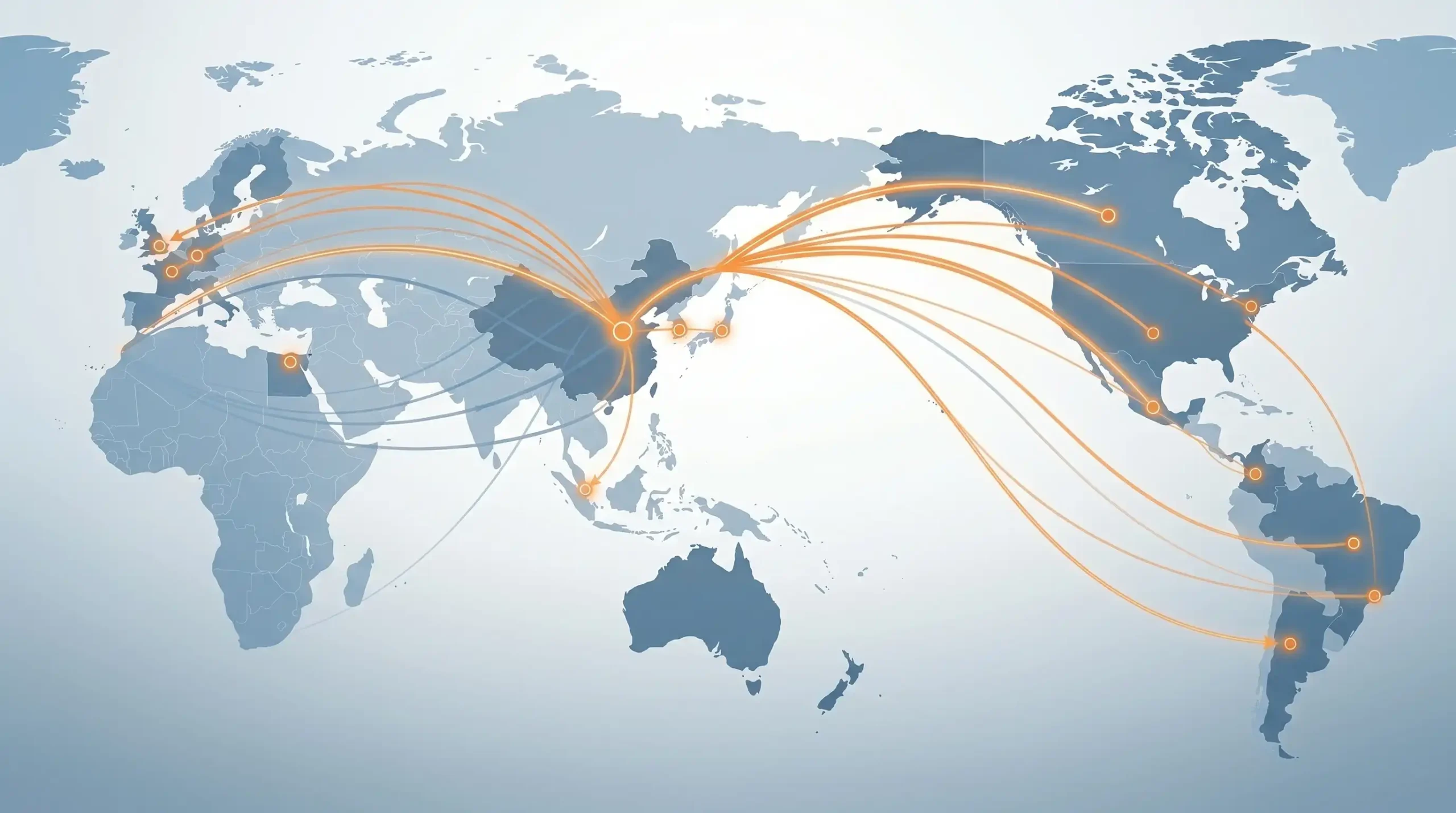
An industrial machinery buyer opens ChatGPT, Gemini or Perplexity today and asks which manufacturers lead their category. The answer they receive is not decided by machine quality, real market share, or decades of international presence. It is decided by the English-language content each manufacturer has left circulating on the web.
On that terrain, established European manufacturers have been losing for years. It just didn’t matter until now.
The question that defines the problem
In March 2026 we ran a sector experiment across five query blocks on five AI platforms — Gemini Free, Gemini Advanced with Thinking, ChatGPT, Perplexity and Claude — focused on flat glass cutting and processing machinery. This is a mature B2B industrial sector, dominated in channel reputation by four European manufacturers: LiSEC (Austria), HEGLA (Germany), Bottero (Italy) and Intermac (Italy). These four have been the technical reference of the sector for decades.
The question framing the experiment was simple: when a prospective buyer asks an AI about glass cutting machinery without providing additional context, which names appear?
» best flat glass cutting machine manufacturer
» alternatives to LiSEC for glass cutting
» linear motor glass cutting machine
» European glass machinery manufacturer Latin America
The result was not what we expected.
What the AI returns when the query is generic
For the query “best flat glass cutting machine manufacturer,” the pattern repeats consistently across platforms. Standard Gemini cites HEGLA alongside Caremachine and CMS as reference manufacturers. Caremachine is Shandong Care Machinery Technology, a Chinese manufacturer based in Jinan. CMS is CMS Glass Machinery, founded in Turkey in 1995. HEGLA is the only first-tier European in the response.
Perplexity builds its response from nine cited sources, dominantly Chinese sites and industrial directories. The model’s suggested follow-ups point to HEGLA, EastGlaz and CMS. EastGlaz is Jinan Lijiang Automation Equipment, a Chinese manufacturer headquartered in Shandong with commercial agents in South America, Europe, Southeast Asia and the Middle East.
ChatGPT lists six to eight manufacturers with technical detail — specific models, tolerance ranges, cutting speeds. The list includes Intermac, HEGLA, Bottero, LiSEC, Keraglass. Claude cites LiSEC, HEGLA, Metoree, DirectIndustry and Billco as primary sources. Gemini Advanced with Thinking — the only model with advanced synthesis capability — does include one mid-sized European manufacturer (TUROMAS, Spain), but only in the second query block.
The pattern is clear: in generic global queries about industrial manufacturers, Chinese players are systematically present in the responses of standard models — the ones used by 95% of real buyers. Established European manufacturers do appear, but without exclusivity.
| Platform | European manufacturers cited | Chinese manufacturers cited | Others |
|---|---|---|---|
| Gemini Free | HEGLA | Caremachine | CMS (Turkey) |
| Gemini Advanced (Thinking) | HEGLA, Bottero, Intermac, LiSEC, TUROMAS | — | CMS (Turkey) |
| ChatGPT | HEGLA, Bottero, Intermac, LiSEC, Keraglass | — | — |
| Perplexity | HEGLA (suggested follow-ups) | EastGlaz, Chinese sites in 9 sources | CMS (Turkey) |
| Claude | HEGLA, LiSEC | — | Billco (USA), Metoree, DirectIndustry (directories) |
Manufacturers cited in response to the query “best flat glass cutting machine manufacturer” by platform. March 2026.
The buyer who no longer arrives
When a European industrial manufacturer reviews its digital presence metrics, it sees what it has built in its traditional sector: trade shows, distributors, specialist press, reputation among clients. That presence is real, and it works.
But when a prospective buyer no longer consults those channels — because they begin their research in ChatGPT or Gemini — the filter changes. What enters the AI’s response is what has been published in English with sufficient technical density. And on that terrain, Chinese manufacturers have spent ten years building what European manufacturers have not.
This is not exclusively a Chinese phenomenon. CMS Glass Machinery, cited repeatedly by AI platforms as a reference, is Turkish. The pattern is not geographic — it is architectural. Manufacturers that grew by selling into international markets built their English-language presence from the start. European manufacturers that grew through channel reputation and trade-show presence did not — and AI models only read the former.
The argument is not that Chinese manufacturers will displace established players tomorrow. It is more subtle: Chinese manufacturers are already inside the responses received by a buyer who does not yet know you. If your real competitive position depends on being known — because your product is superior, because your reputation matters when you are evaluated — the AI is cutting that connection before it can happen.
The buyer never finds you, never knows you exist.
The apparent exception: the TUROMAS case
There is one European manufacturer that appears consistently in this experiment on a specific query. TUROMAS, a Spanish manufacturer with 40 years of history and direct subsidiaries in Mexico, Colombia, Chile and Brazil, appears across all five platforms when the query includes “Latin America European manufacturer.” Gemini Free places them in first position, ahead of LiSEC.
At first glance, this looks good. And it is.
But it is a geographically concentrated position. When the query turns generic — “best flat glass cutting machine manufacturer” — TUROMAS disappears from four out of five platforms. And on the query about the technology where they have demonstrated innovation leadership since 2000 — linear motor technology in glass cutting machines, documented in sector publications — the models omit them from the main response while citing Yinrui, a Chinese manufacturer based in Dongguan, as a reference.
Being well-positioned in Latin America is real. But it is also the last territory where the classic logic of commercial presence still operates inside AI responses. And Chinese manufacturers are already publishing English-language content with explicit geographic segmentation: EastGlaz declares commercial agents in South America; Yinrui lists exports to Mexico, Argentina and Peru visibly on its corporate site.
The open question isn’t whether TUROMAS is well-positioned in Latin America today. It is. The question is for how long.
What the AI decides before you know it
The conversation about industrial machinery on AI platforms is already happening. Every day, thousands of prospective buyers begin their research there and receive lists of recommended manufacturers. They will not buy what the AI tells them — these are six- or seven-figure purchases and nobody signs a purchase order based on a ChatGPT response. But they will likely contact first the names that appeared. In industrial machinery, the first call is a competitive advantage that is not easily recovered. Manufacturers who appear win that first contact. Manufacturers who do not appear are out of the short list — and never find out it existed.
Those appearing today did not necessarily work for it. Some arrived through paths that had other objectives at the time — selling abroad, capturing international leads through cheap channels, competing on SEO in markets that were not their own. The content they left along the way, in English and with technical density, now feeds the models.
Other manufacturers — more established, better known in their traditional markets — invested in other things. Channel reputation. Trade shows. Long relationships with distributors and clients. Reasonable decisions at the time, and still valid in many ways.
This is a similar pattern we documented when an Estonian accounting platform outranked every Spanish competitor in AI recommendations for the Spanish freelance market — a sector where local players had decades of incumbency and the outsider has been just 5 years in the market.
But buyers no longer ask only where they used to ask.