
Strategy · GEO
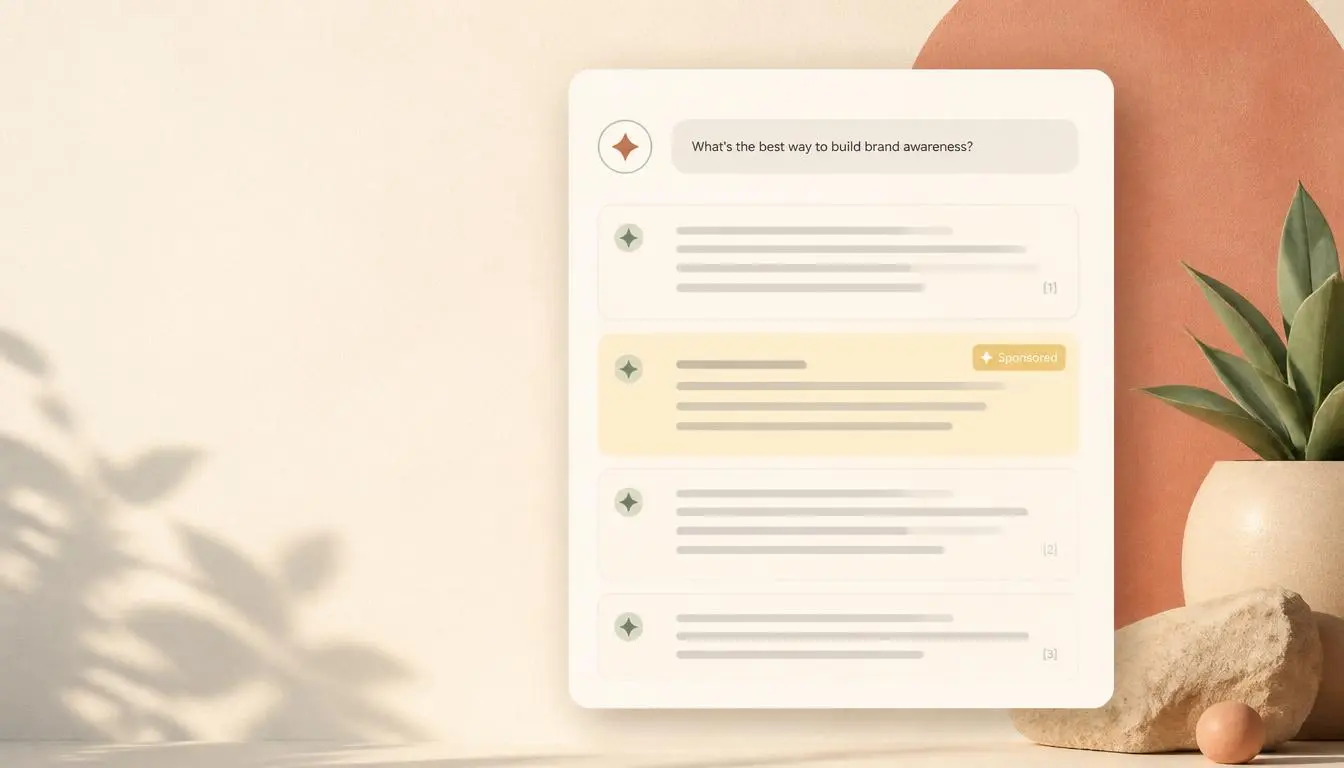
Google just did something that changes the rules: it has started placing ads inside the answer its AI generates. Not beside it. Not above it. Inside the flow of the conversation, between the recommendations, with a “Sponsored” label that plenty of users will never look at.
The immediate reaction was panic: SEO is dead, now you have to pay to show up in the AI. That is the wrong read. The good news — and the uncomfortable one — is that the paid placement does not buy the organic citation. It sits next to it. And that means the question that actually matters for your business is not how much the ad costs, but why the AI isn’t already citing you for free.
What Google actually announced
At Google Marketing Live 2026, during the week of the May I/O event, Google introduced two ad formats for AI Mode — its conversational search interface — and was explicit about them from day one: Conversational Discovery ads and Highlighted Answers, both powered by Gemini, carrying a “Sponsored” label and an independent “AI explainer” written by the model itself. Conversational Discovery ads answer a specific question inside the conversation; Highlighted Answers insert the ad inside the recommendation lists. The two AI Mode formats are in testing as of May 2026, with no confirmed public surfacing date.
They don’t come alone. Google also confirmed AI-powered Shopping ads — rolling out across the United States through the year — and a Business Agent for Leads in open beta for US advertisers. The Business Agent for Leads is a branded chatbot that plugs directly into the search block: the user talks to the company without leaving Google.
The framing this story got on social media overstates it. “Google no longer keeps search ad-free” sounds like a headline, but Google search was never ad-free. What’s new is not that there are ads: it’s where they sit. The ad no longer lives at the top or bottom of the page, but in the middle of the answer the user is reading as if it were neutral.
The nuance almost nobody is flagging
Here is the line that separates serious analysis from noise. None of the big three — Google with AI Mode, Microsoft with Copilot, OpenAI with ChatGPT — lets an advertiser pay to change the organic answer the AI generates. The money buys a labelled space next to the answer. It does not buy the content of the answer.
That completely changes the correct conclusion. You’ll often read these days that SEO is no longer about ranking links but about being cited inside the generated answer, sometimes next to a paid placement. The second part is true. The first describes exactly the GEO problem that already existed before these ads arrived and that still exists unchanged: the AI chooses who to cite in its organic answer based on what it finds documented, not on who pays.
If your company doesn’t appear in the AI’s organic answer, the ad doesn’t solve your underlying problem. It rents you a visibility that lasts as long as the budget does. The organic citation — when the model recommends you because your content is the best source available — isn’t rented. It’s built.
What does it cost to “enter the AI conversation”?
The short answer: there is no fixed rate. It works by auction, inside Google Ads’ automated campaign systems. Performance Max is the format where the advertiser hands over objectives and creative and lets Google’s AI decide where and when to show the ad across its whole ecosystem; AI Max for Search is its more recent, search-oriented version, where keywords stop being the main factor and the model interprets the intent of the query to place the ad. Anyone already using either format automatically qualifies for the AI Mode placements: there’s no separate campaign to create. Classic Search, Display or Video campaigns don’t qualify yet.
Google did publish some behavioural data that helps size why it is building ad formats specifically for this surface rather than porting existing ones: according to Google, AI Mode searches are on average three times as long as traditional searches, and one in six queries is non-text — voice or image. Those are the conditions a marketing manager should weigh before assuming a classic-search playbook transfers cleanly.
On relative cost, the figures circulating are softer and need handling with care. Agency data compiled in early 2026 reports that ads now appear in around 25.5% of AI results — but the underlying source measures ads alongside AI Overviews, up from roughly 5% in early 2025, not AI Mode specifically; the two surfaces are related but not the same, and the figure should not be presented as an AI Mode metric. The same body of agency reporting describes early-tester engagement on AI search ads running materially higher than traditional search ads, but at a higher cost per click. These are early estimates from agency aggregation, not official Google numbers. They’re useful to size the trend — entering the AI conversation is more expensive than classic search — not as a guarantee of what your account will pay.
All of the above is in testing in the United States only. In most other markets these formats aren’t available yet. Whoever starts understanding the mechanics now arrives prepared; nobody is buying a Conversational Discovery ad in Europe next week.
The question the ad doesn’t answer
So — is SEO dead and now you just pay? No. What’s happening is more interesting. Search is splitting into two layers: a paid layer, labelled, rented by auction; and an organic layer — the recommendation the AI makes on its own — that still depends on what your company has documented and citable.
The mental trap is thinking the paid layer replaces the organic one. It doesn’t replace it: it coexists with it, and the user is getting better and better at telling apart what they’re recommended because it’s good from what they’re shown because someone paid. The ad budget buys temporary presence. Content architecture buys the citation the model makes when nobody has paid anything.
If you want to understand why the AI recommends some companies and not others — regardless of who advertises — the starting point is the same as always: what GEO is and why your company doesn’t appear in AI answers. And if your first instinct is to ask ChatGPT whether your business is well positioned, it’s worth reading first why the AI is the worst place to self-diagnose your visibility: models tend to confirm what you want to hear, not to audit what is actually happening.
The AI Mode ad is big news for anyone managing an advertising budget. But it doesn’t change the underlying question, it only makes it more urgent: when someone asks the AI for the best service in your category and nobody has paid, do you appear?
If this analysis made you rethink the difference between renting visibility and building it, share it with your marketing team on LinkedIn — it’s exactly the debate worth having before these formats reach your market. And if you want to follow the topic closely, the sector-by-sector visibility experiments we publish show, with real data, who the AI cites when nobody pays.